
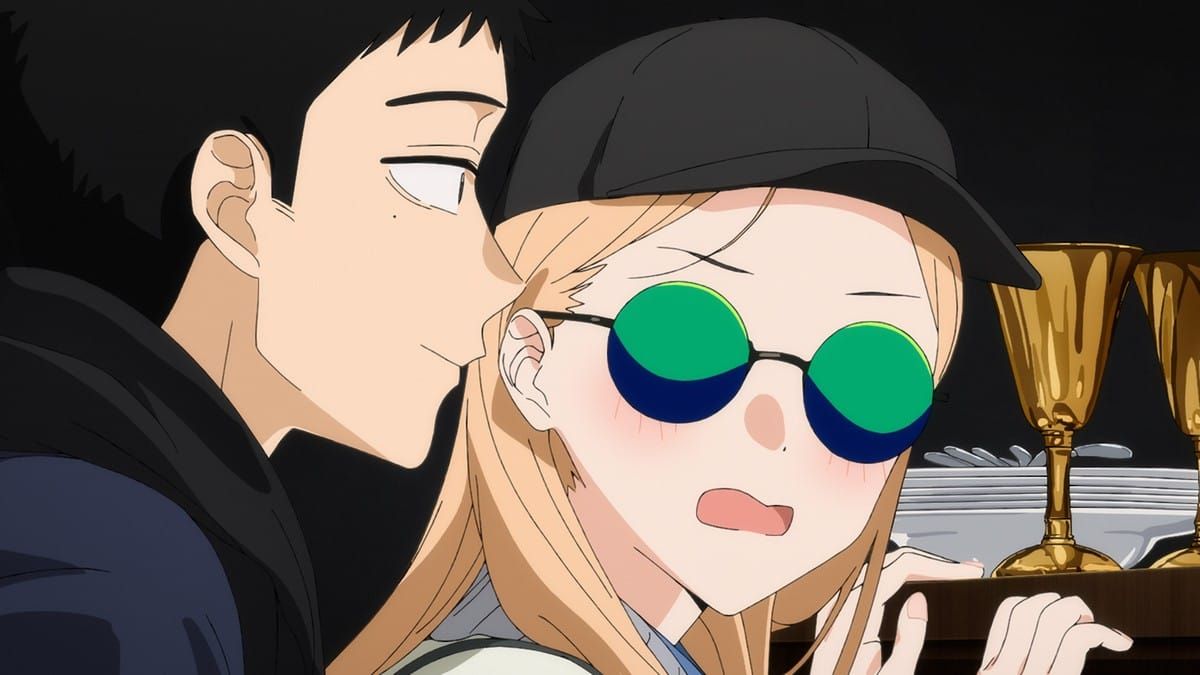
It took mere seconds for Wakana Gojou to be made an outsider. Yearning for a moment of connection, he shares his love of hina dolls with a friend. He receives nothing but rejection. In the moment his friend screams “its weird that you like dolls,” she relegates him to living outside a strict gender binary of woman/man. He becomes something other, something distasteful. If he is not a man, then what else could he be but inhuman? Understanding he does not belong in our gendered world, Gojou spends most of his childhood and teenage years self-policing. He makes himself small, insular, so much so that he no longer represents a person. He becomes a sliver, a fraction of a fraction, meant to disappear from the world.
And then, just when we feel the loneliness build to a breaking point, Kitagawa’s panties flash across the screen. There is no more tension, only the blatant horniness of some studio execs looking to make some money.
My Dress-Up Darling is a show of... contrasts. On the one hand, we have gratuitous panty-shots and a cookie-cutter heterosexual will-they-won’t-they romance. On the other, we have subversive women obsessed with hentai, gratuitous horror, and best-girls existing alongside sewing-aficionado doll-loving cross-dressing men. It is a show that is simultaneously obsessed with being uncomfortably, leeringly horny, and deeply concerned with the ways gender fucks up our relationships. I, unfortunately, love it. My Dress-Up Darling is queerness for cishets, and when it’s not busy ogling, it wants to create a softer, less rigidly gendered world.
The Alienation of Guys Being (And Loving) Dolls
On the surface, My Dress-Up Darling appears to be a show following a bumbling man as he watches hot girls do cosplay. Unfortunately, it never manages to fully shake off it’s ogling horniness, but the show does have more on it’s mind than panty shots. While it could have gotten away with the typical path of making every man a 2-dimensional cardboard cutout, My Dress-Up Darling chooses to do something more difficult. The men of My Dress-Up Darling are made 3-dimensional through the ways they grapple with their ‘queer’ gender expressions.
The protagonist, Gojou, isn’t queer in the sense of identity: he identifies as a cis man and is attracted to women. Rather, Gojou is marked as queer pejoratively early in his childhood due to his love of dolls, a mark he carries like a grave sin into his teenage years. My Dress-Up Darling goes to great lengths to demonstrate how he self-polices his own gender expression, hiding his hobbies (sewing and dolls) and chastising himself for every desire (including hetero-normative ones like, shockingly, thinking women are hot). In Gojou’s head, everything makes him a creep.
Gojou is not the only man who is worried he is a creep. Himeno loves to cross-dress as a hobby, especially when it comes to cosplay. While his family is supportive, he has been ragged on most of his life for his femininity, even having a date yell at him when she discovers his hobby. Himeno’s self-policing is less intense than Gojou’s, but is still present. When being asked for photos, he insists on clarifying to everyone that he is actually a man. When Gojou initially asks why Himeno loves to cosplay, his defenses go up, stating “When you asked me about cosplaying female characters, I thought you’d tell me I’m creepy.”
What Gojou and Himeno have internalized is an alienizing logic, “a structure of thinking that insists that some are necessarily a part of a community and some are recognized as not belonging.” Outside of their families, both Gojou and Himeno have separated out the part of themselves they consider ‘alien’ from their communities so they can continue to ‘belong.’ Gojou tells no one about his dolls, and Himeno rarely cross-dresses at events.
However, no matter how much they bury themselves, neither of them feel a sense of belonging. Every time Gojou and Himeno choose to follow a hetero-normative alienizing logic, they are locked off from real connections. In their loneliness, they always assume the worst of others, believing they will be chastised for being themselves. Suppressing their identities does not magically make them part of a community of men. Instead, it performs the ultimate goal of a hetero-normative alienizing logic: to quarantine the ‘queers’ so they can’t ‘infect’ anyone else.
The Bittersweet Taste of Liberating Your Desires
On the surface, Kitagawa presents as a sexually liberated woman. Her open adoration of hentai games and constant willingness to tease Gojou about sex make it seem like she could talk her way through any awkward conversation. She keeps up this facade through the first half of season one, but it falls apart the moment she realizes she has feelings for Gojou.
The problem Kitagawa faces is that her air of sexual liberation doesn’t hold up when things get serious. When it comes to sharing her feelings for Gojou, she keeps them down, worried they would somehow destroy their friendship. When her and Gojou end up on top of one another in a love hotel, she can’t bring herself to say anything in the moment or anytime afterward. She only gets to be free and liberated when it is played for laughs. Expressing her honest desires, especially her honest sexual desires, goes against the social script she was given as a 'carefree' and 'silly' woman.
Kitagawa is not the only one with a constant inability to express her desires. When Gojou first gets asked to make a dress for Kitagawa, the timeline she gives him is way too short. Rather than tell her he can’t do it, Gojou does the ‘manly’ thing, suppressing his needs and getting the dress done at the cost of his health. Akira spends most of season 2 being cold to Kitagawa, so much so that Kitagawa believes Akira hates her. In reality, Akira thinks of Kitagawa as her “best girl,” but was never given the tools to properly express her adoration of another woman.
The inability to express desire is a problem the queer community is intimately aware of. As AJ Mason points out, “many of us [in the queer community] have already had to overcome heteronormative and cisnormative relationship scripts.” We are raised to believe that certain desires and interactions are normal, and that anything outside of them is to be repressed. Women don’t openly express sexual desire, men bury their feelings, and adoration of the same gender is frowned upon. My Dress-Up Darling highlights how those scripts harm even cishet people. Under cisheteronormativity, everyone is stuck with the tension between what is expected of them and what they actually desire.
It is a shame, then, that the show frequently undercuts this tension with the gratuitous sexualization of teenagers. Kitagawa, Juju, and Shinju all receive lovely story moments addressing these tensions that are undercut by sudden, hypersexualized shots. What sucks is that sexualization handled well and with adult characters can add something to a show’s explorations of gender. However, in the case of My Dress-Up Darling, it is just a distraction. A thoughtful story is used as an excuse to ogle teenagers. Unfortunately, My Dress-Up Darling knocks it out of the park when exploring its characters desires, only to trip over its own shoelaces because it was too busy staring at Kitigawa’s ass.
A Way Out
When Gojou first learns of Kitagawa’s love of hentai games, his immediate reaction is to turn his inner cop against her, stating “isn’t it weird for girls to like those kind of games?” Kitagawa responds plainly, “when you love something, does gender even matter?” Her rebuke is one of kindness, not meant to shut Gojou out, but to make him question the things he was keeping in the whole time. His enthusiastic “of course” in reply is his first release, the first time he has a taste of what it is like to kill the cop in your head.
Of course, Gojou doesn’t suddenly become the type to wear his heart on his sleeve. Instead, as he slowly gains more friends with a wide array of experiences, he breaks more of the assumptions and social scripts he led his life by. He learns that it is not weird for men to enjoy dolls, sewing, or makeup, just like it isn’t weird for women to enjoy swords, horror, or hentai. Gojou follows Butler’s advice in Undoing Gender, understanding that to create social transformation we must work “to stay at the edge of what we know, to put our own epistemological certainties into question, and through that risk and openness to another way of knowing and of living in the world to expand our capacity to imagine the human.”
Gojou started the show with his humanity being ripped away from him. The small-mindedness of other’s thoughts on what was ‘normal’ for a boy kept him isolated. But it was not an inescapable trap. Through community, Gojou discovers just how arbitrary the borders we erect around each other are, and just how joyous it is to knock them down.